Claude Opus 4.6 vs GPT-5.4 vs Gemini 3.1 Pro: Which AI Model Wins for Coding?
By Ashish Singh
June 2, 2026


Table of Contents
The frontier AI coding race reached a genuine inflection point in early 2026. Within a six-week window, Anthropic shipped Claude Opus 4.6, Google released Gemini 3.1 Pro, and OpenAI followed with GPT-5.4, each claiming leadership on at least one major coding benchmark. For engineering leaders, CTOs, and product teams trying to make real infrastructure decisions, the overlap is both exciting and frustrating.
The stakes are not trivial. AI-assisted coding is no longer a developer productivity tool. It is fast becoming the primary driver of software delivery speed across enterprise and startup environments. Teams that select the right frontier model for their specific workflow and stack will ship faster, debug more reliably, and scale agentic pipelines with fewer human interventions.
This comparison covers the Claude vs GPT-5 vs Gemini coding 2026 landscape across seven dimensions: raw benchmark performance, agentic coding capability, context window handling, pricing economics, enterprise readiness, real-world strengths, and workflow fit. The goal is not a generic ranking but a practical decision guide for engineering organizations building real products.
By the time you finish reading, you will know exactly which model (or combination of models) belongs in your development stack.
Before diving into model-by-model analysis, it helps to understand what the benchmarks actually measure and where their limitations lie.
SWE-bench Verified tests a model’s ability to resolve real GitHub issues from open-source repositories. It simulates the kind of debugging and code repair that engineers do daily. A higher score here means the model is better at understanding a codebase, identifying the root cause of failures, and writing correct patches without being told exactly where to look.
SWE-bench Pro is a harder variant. It introduces tasks that require multi-file reasoning, longer context retention, and fewer scaffolded hints. This benchmark correlates more closely with production-grade software engineering.
Terminal-Bench 2.0 evaluates agentic terminal workflows: multi-step command execution, planning, tool coordination, and error recovery without human intervention. This benchmark matters most for teams building DevOps automation, CI/CD agents, and backend pipeline tools.
LiveCodeBench Pro pulls from competitive programming platforms including Codeforces, ICPC, and IOI. It is harder to game through training data memorization, making it a stronger signal for algorithmic reasoning.
The key insight: no single benchmark captures everything. A model can lead SWE-bench and trail on LiveCodeBench. Another can dominate Terminal-Bench while being outpaced on complex multi-file reasoning. The right question is not which model has the highest single score but which benchmark profile maps to your actual workflow.
With that context established, here is what each model brings to the table.
Anthropic released Claude Opus 4.6 on February 5, 2026. The model was positioned explicitly around agentic coding, long-context reliability, and enterprise workflow integration.
Claude Opus 4.6 achieves the highest agentic coding scores Anthropic has delivered to date: 80.8% on SWE-bench Verified, 65.4% on Terminal-Bench 2.0, and 72.7% on OSWorld for agentic computer use.
On ARC-AGI-2, which resists memorization and measures genuine generalization ability, Opus 4.6 scores 68.8% — a dramatic leap from the 37.6% achieved by its predecessor. For comparison, GPT-5.2 scored 54.2% and Gemini 3 Pro scored 45.1% on this same benchmark.
The 1M context window is the upgrade that matters most in practice. To put it in perspective: 1M tokens covers roughly 750 novels, an entire enterprise codebase of several thousand files, or a full legal discovery set, processed in a single prompt.
For software engineering, this means Opus 4.6 can reason across an entire monorepo without chunking. A team working on a 300,000-line codebase can feed the full source into a single prompt and ask the model to trace a bug across layers, refactor a shared module, or generate integration tests that account for every dependency.
Anthropic claims the extended context maintains coherence through a new retrieval mechanism, and the MRCR v2 benchmark backs this up: Opus 4.6 scores 76% at 1M tokens compared to 18.5% for GPT-5.2 at the same length.
One of the most significant architectural additions in Opus 4.6 is Agent Teams, which enables multi-agent orchestration within Claude Code. Engineering teams can now spin up multiple specialized subagents (one for testing, one for documentation, one for refactoring) that coordinate under a single orchestrating prompt. This dramatically reduces the number of human checkpoints needed in complex development workflows.
GPT-5.4 represents a fundamental shift in what a single model can do. Rather than offering separate specialist models for coding, reasoning, and computer use, GPT-5.4 rolls everything into one unified architecture. It scores 57.7% on SWE-bench Pro, 75% on OSWorld for computer use, and 83% on GDPval for knowledge work.
The headline OSWorld number matters: GPT-5.4’s 75% score surpasses the human expert baseline of 72.4%. This is not a coding benchmark in the traditional sense, but it signals that GPT-5.4 can operate a full development environment autonomously: opening files, running tests, reading error output, and iterating without human direction.
GPT-5.4 adds native computer use, Tool Search (which delivers a 47% token reduction in tool-heavy workflows), and a 1M context window in Codex mode. For enterprise teams running high-volume agentic pipelines, the token reduction alone translates to substantial infrastructure cost savings.
GPT-5.5 (the subsequent release) is faster and makes fewer tool calls to complete equivalent tasks, with Claude producing more careful output and better handling of edge cases and uncertainty. For speed-critical agentic coding, GPT wins on throughput; Claude wins on correctness depth. The same tradeoff is visible in GPT-5.4: it is optimized for execution pace over exhaustive reasoning.
GPT-5.4 wins on SWE-bench Pro at 57.7% versus approximately 46% for comparable Claude variants, and on Terminal-Bench at 75.1% versus 65.4%. These are the benchmarks OpenAI emphasizes most, and for good reason: they test realistic production scenarios that go beyond single-file patch generation.
GPT-5.4 is listed at $2.50 per million input tokens and $15 per million output tokens, compared to Claude Opus 4.6 at $5 per million input and $25 per million output. For teams running at scale, this pricing differential compounds quickly. A team processing 10 million tokens daily would save roughly $7,500 per month using GPT-5.4 over Opus 4.6 at list prices.
Google released Gemini 3.1 Pro on February 19, 2026 as their most capable model to date. It is described as designed for tasks where a simple answer isn’t enough.
Gemini 3.1 Pro combines competitive coding performance (2887 Elo LiveCodeBench), strong real-world software engineering results (80.6% SWE-Bench Verified), and a massive 1M token context at $2/$12 pricing.
The numbers here require attention from any engineering organization thinking about budget-conscious AI adoption. At $2 per million input tokens and $12 per million output tokens, Gemini 3.1 Pro is 7.5x cheaper than Claude Opus 4.6 on input. At the same time, it trails Opus 4.6 on SWE-bench Verified by only 0.2 percentage points (80.6% vs 80.8%).
For most production coding workloads, a 0.2-point benchmark difference is not statistically meaningful. The cost difference, however, is very real.
Gemini 3.1 Pro delivers a 2x-plus reasoning boost over Gemini 3 Pro, ranks first on 12 of 18 tracked benchmarks, and supports 1M token context with 65K token output.
Gemini 3.1 Pro’s key verified benchmark scores include: ARC-AGI-2 at 77.1%, GPQA Diamond at 94.3% (reported as the highest recorded score on this benchmark), LiveCodeBench Pro at 2887 Elo, and SWE-Bench Verified at 80.6%.
The ARC-AGI-2 score is particularly relevant for developers working on novel algorithmic problems: tasks that cannot be solved through pattern matching or training data recall. At 77.1%, Gemini 3.1 Pro leads both Claude Opus 4.6 (68.8%) and GPT-5.2 (54.2%) on this benchmark.
For teams building competitive programming tools, code evaluation platforms, or algorithmic components, LiveCodeBench Pro is the most relevant benchmark. Gemini 3.1 Pro achieves 2887 Elo on LiveCodeBench Pro, which uses real competitive programming problems from Codeforces, ICPC, and IOI. No other frontier model comes close to this score in the February-April 2026 evaluation window.
For enterprises already inside the Google Cloud ecosystem, Gemini 3.1 Pro offers native integration advantages. It ships inside Google Workspace, connects directly to Vertex AI, and deploys through Android Studio for mobile development teams. These integrations reduce the operational overhead of adopting AI coding assistance at scale.
The clearest way to understand where each model wins is to look at the benchmark results side by side and then translate them into workflow implications.
On SWE-bench Verified (real GitHub issue resolution): Claude Opus 4.6 leads narrowly at 80.8%, Gemini 3.1 Pro is essentially tied at 80.6%, and GPT-5.4 comes in lower on this specific benchmark while outperforming on SWE-bench Pro.
On SWE-bench Pro (harder multi-file resolution): GPT-5.4 leads at 57.7%, followed by Claude Opus 4.6 and Gemini 3.1 Pro at 54.2% and lower. This benchmark better reflects the complexity of real enterprise engineering environments.
On Terminal-Bench 2.0 (agentic terminal automation): GPT-5.4 leads at 75.1%, Claude Opus 4.6 at 65.4%, and Gemini 3.1 Pro at 68.5%. For DevOps automation and terminal-based workflows, GPT has a clear edge.
On LiveCodeBench Pro (competitive programming): Gemini 3.1 Pro leads decisively at 2887 Elo. This is the strongest signal for teams working on algorithmic complexity.
On ARC-AGI-2 (generalization and novel reasoning): Gemini 3.1 Pro leads at 77.1%, Claude Opus 4.6 at 68.8%, GPT-5.2 at 54.2%.
The headline conclusion: there is no universal winner. Each model leads on at least two major benchmarks and trails on at least one. The right model depends on your specific workload profile, not aggregate scores.

Pricing in the frontier AI space is not as simple as comparing per-token rates. The true cost of deploying AI coding assistance includes token volume, caching utilization, output token ratios, and the efficiency of model task completion (fewer retry loops means fewer total tokens consumed).
Here is a summary of current API pricing for the three models as of Q1-Q2 2026:
| Model | Input (per 1M tokens) |
Output (per 1M tokens) |
Context Window | Max Output |
|---|---|---|---|---|
| Claude Opus 4.6 | $5.00 | $25.00 | 1M tokens | 128K tokens |
| GPT-5.4 | $2.50 | $15.00 | 1M tokens | 128K tokens |
| Gemini 3.1 Pro | $2.00 | $12.00 | 1M tokens | 65K tokens |
API pricing comparison for Claude Opus 4.6, GPT-5.4, and Gemini 3.1 Pro. Verify current pricing before procurement.
For teams evaluating total cost of ownership rather than raw benchmark position, Gemini 3.1 Pro offers the most compelling economics. Claude Opus 4.6 justifies its premium through higher output token limits (128K vs 65K) and stronger performance on complex multi-file agentic tasks that would otherwise require multiple model calls to complete.
GPT-5.4’s token efficiency advantage through Tool Search effectively reduces the real-world cost gap with Claude for agentic workflows. Tool Search delivers a 47% token reduction in tool-heavy workflows, which significantly improves GPT-5.4’s effective cost per completed task.
For enterprise procurement cycles, the right framing is cost per successfully completed coding task, not cost per million tokens. A model that costs more per token but completes tasks in fewer calls may be cheaper overall.
For enterprises managing codebases above 200,000 lines, the 1M token context window is essential. All three models now support it. The differentiator is what each model does with that context.
Claude Opus 4.6 performs best on tasks that require deep understanding across multiple files simultaneously: tracing a data flow bug through 12 interdependent modules, refactoring a shared authentication layer that affects 40 services, or generating integration tests that cover edge cases across layers. The 128K max output token limit also means Claude can generate entire feature implementations in a single response, eliminating multi-call assembly.
GPT-5.4 performs best when the task involves executing steps in a terminal environment: running builds, parsing error logs, iterating on fixes, and validating results through tool use. Its computer use capability means it can interact directly with a development environment rather than generating code for a human to run.
Gemini 3.1 Pro performs best when the primary constraint is repository-wide context at controlled cost. For daily code review workflows across a large monorepo, its combination of 1M context, competitive SWE-bench performance, and low per-token pricing makes it the operationally sensible choice.
Financial services development involves unusually strict requirements: precise numerical handling, audit trail generation, regulatory compliance validation, and security-first code patterns. Claude Opus 4.6’s strong performance on BigLaw Bench (90.2%) is a proxy for its capability on compliance-heavy analysis tasks. For FinTech teams building payment processing, risk modeling, or regulatory reporting systems, Claude’s tendency toward careful, qualified output with fewer hallucinated assertions reduces compliance risk in generated code.
In HealthTech development, incorrect logic can cause patient safety issues and HIPAA violations. The model characteristic that matters most here is not speed or cost but reliability and edge case handling. Claude Opus 4.6’s stronger performance on complex reasoning benchmarks and its more careful approach to uncertainty make it the lower-risk choice for medical data pipelines, clinical decision support tools, and patient-facing application logic.
For DevOps teams building CI/CD agents, infrastructure-as-code generators, and automated testing pipelines, Terminal-Bench 2.0 performance is the most relevant benchmark. GPT-5.4’s lead at 75.1% reflects its strength in multi-step terminal workflows. Teams using GitHub Actions, Terraform, Kubernetes configuration generation, or automated deployment pipelines will find GPT-5.4’s agentic terminal capabilities the most practically relevant.
EdTech applications often combine complex backend logic with high-quality content generation. Gemini 3.1 Pro’s GPQA Diamond score of 94.3% (the highest recorded on this benchmark as of February 2026) indicates strong graduate-level reasoning. For platforms building adaptive learning systems, automated assessment engines, or subject-matter tutoring tools, Gemini’s reasoning depth combined with its low inference cost makes it an attractive choice.
Startups evaluating frontier AI models for coding face different constraints than enterprises. Speed of iteration matters more than compliance overhead. Cost per experiment matters more than per-task optimization. And the model choice often needs to scale from MVP to Series A without changing infrastructure.
For pre-seed and seed-stage teams: Gemini 3.1 Pro’s pricing economics are compelling. At $2 per million input tokens, a small team running daily AI-assisted development can keep monthly AI infrastructure costs below $500 even at moderate usage. The SWE-bench performance is competitive, and the context window handles most startup codebase sizes comfortably.
For Series A and growth-stage startups: The choice shifts based on product type. Teams building developer tools, data infrastructure, or enterprise SaaS will benefit from Claude Opus 4.6’s stronger multi-file reasoning and Agent Teams capability. Teams building consumer applications, marketplace platforms, or content products may find Gemini 3.1 Pro’s cost efficiency and Google ecosystem integration more valuable.
For AI-native products: Startups building products that embed AI coding assistance into their own platform need to evaluate model API reliability, rate limits, and SLA guarantees alongside benchmark performance. All three models are available through major cloud providers (AWS Bedrock, Google Cloud Vertex AI, and Azure OpenAI Service), which simplifies multi-model deployment and provides enterprise-grade uptime guarantees.
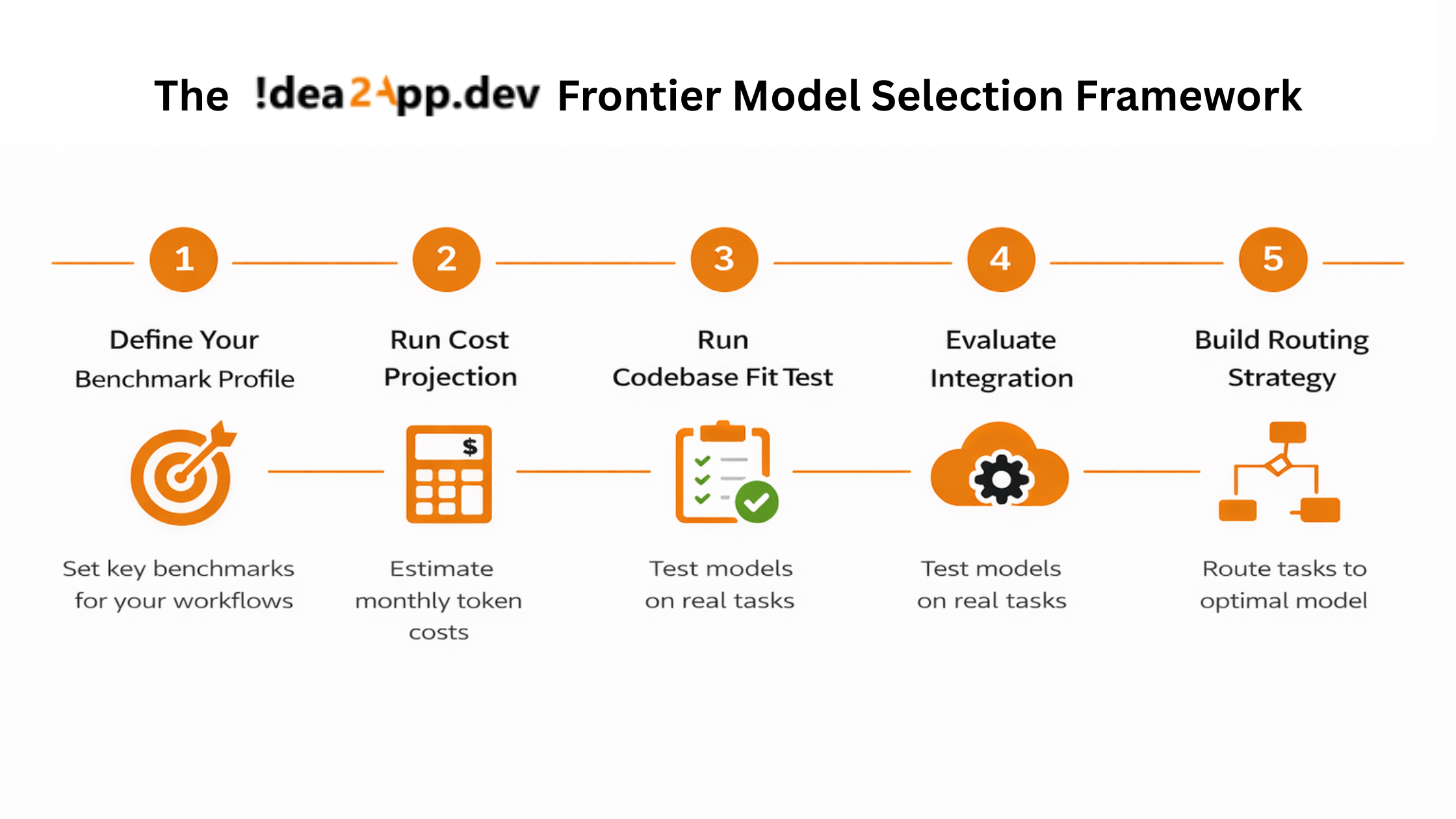
Selecting the right frontier coding model is not a one-time decision. It is a repeatable evaluation process that should run every six to eight weeks as new model releases shift the performance landscape. Below is the Idea2App Frontier Model Selection Framework (FMSF), a structured approach for engineering organizations to make this decision systematically.
Start by identifying which benchmark categories matter for your primary engineering workflows. Score each category from 1 to 5 by importance:
Your weighted scores reveal which model’s benchmark profile aligns most closely with your actual work.
Using your team’s estimated monthly token consumption, project costs for each model at list prices. Factor in caching utilization (Gemini 3.1 Pro supports up to 75% cost reduction through context caching), output token ratios for your task types, and expected retry rates based on task complexity.
Before making a production selection, run each model on 10 real tasks from your own codebase. Include at least three multi-file tasks, two debugging scenarios, and two new feature implementation prompts. Score each model on first-attempt success rate, output quality, and hallucination incidents.
This step consistently reveals performance gaps that benchmarks do not capture, particularly around project-specific conventions, internal API naming patterns, and framework-specific idioms.
Map each model against your existing infrastructure. Identify whether your team uses AWS, Azure, or Google Cloud and assess the integration cost of adopting each model. Consider whether your IDE tooling (VS Code, JetBrains, Cursor) has native support or requires a custom connector.
The most sophisticated engineering organizations in 2026 do not use a single model. They route tasks to the model best suited for that task type. A typical routing strategy might send complex multi-file refactoring tasks to Claude Opus 4.6, high-volume boilerplate generation to Gemini 3.1 Pro, and terminal automation tasks to GPT-5.4. This multi-model architecture delivers both performance and cost optimization simultaneously.
Set a calendar reminder to rerun the FMSF every eight weeks. Given the pace of model releases in 2026 (Anthropic, OpenAI, and Google each shipped at least two major releases in the first quarter alone), a selection that was optimal in February may be suboptimal by April. The framework should be treated as a living process, not a one-time evaluation.
 Expert Insight Section
From the Idea2App Engineering Leadership Team:
The most expensive mistake we see enterprise and growth-stage teams make is treating frontier AI model selection as a procurement decision rather than an engineering decision. A procurement-driven process optimizes for price per token, contract terms, and vendor relationship. An engineering-driven process optimizes for task completion rate, error density in generated code, and developer workflow integration. These two processes often produce different answers.
Common mistakes to avoid:
The first is over-indexing on a single benchmark. SWE-bench Verified is the most cited benchmark in 2026, but it tests one type of coding task (patch generation from issue descriptions). If your team spends more time on new feature development than bug fixing, SWE-bench may be less predictive of your actual experience than LiveCodeBench or Terminal-Bench.
The second is ignoring output token limits in production planning. Claude Opus 4.6’s 128K maximum output is a significant advantage over Gemini 3.1 Pro’s 65K ceiling for tasks that generate entire modules or long test suites in a single call. Teams that underestimate output length requirements often discover this limitation at scale, not in evaluation.
The third is failing to evaluate context coherence at actual context lengths. All three models support 1M token contexts, but their ability to reason coherently across that full context varies significantly. Claude Opus 4.6 scores 76% on MRCR v2 at 1M tokens versus 18.5% for GPT-5.2. For large codebase applications, context coherence is as important as raw benchmark scores.
Scalability recommendation:
Build your AI coding infrastructure on a routing layer from the beginning. Starting with a single model is fine for evaluation, but enterprise-scale deployment almost always benefits from routing different task types to different models. The operational overhead of maintaining three model integrations is far lower than the performance penalty of forcing one model to handle workloads it is not optimized for.
Enterprise readiness tip:
Before deploying any frontier model in a production engineering workflow, validate the provider’s data processing agreements against your compliance requirements. All three providers offer enterprise agreements with data isolation guarantees, but the specific terms around training data usage and regional data residency vary. For FinTech, HealthTech, and any regulated industry, this validation step should happen before the technical evaluation, not after.
| Dimension | Claude Opus 4.6 | GPT-5.4 | Gemini 3.1 Pro |
|---|---|---|---|
| SWE-bench Verified | 80.8% | ~84% | 80.6% |
| SWE-bench Pro | ~46% | 57.7% | 54.2% |
| Terminal-Bench 2.0 | 65.4% | 75.1% | 68.5% |
| LiveCodeBench Pro | Competitive | Competitive | 2887 Elo (Leader) |
| ARC-AGI-2 | 68.8% | 54.2% (GPT-5.2) | 77.1% (Leader) |
| Input Pricing | $5.00 / 1M | $2.50 / 1M | $2.00 / 1M |
| Output Pricing | $25.00 / 1M | $15.00 / 1M | $12.00 / 1M |
| Max Context | 1M tokens | 1M tokens | 1M tokens |
| Max Output | 128K tokens | 128K tokens | 65K tokens |
| Context Coherence at 1M (MRCR v2) | 76% (Leader) | 18.5% | Competitive |
| Agent Teams / Multi-Agent | Yes (Native) | Tool Orchestration | MCP Atlas: 69.2% |
| Best For | Complex Multi-file Agentic Coding | Terminal Automation, Speed | Cost Efficiency, Algorithms |
| Cloud Integration | AWS Bedrock, GCP Vertex | Azure, AWS | GCP Vertex, Native |
| Enterprise SLA | Available | Available | Available |
Sources: Anthropic, OpenAI, Google DeepMind official benchmark reports and model cards, Q1-Q2 2026. Verify current pricing before procurement.
The Claude vs GPT-5 vs Gemini coding 2026 comparison reveals a landscape where frontier AI models have converged to within striking distance of each other on most benchmarks, while diverging meaningfully in their architectural strengths and cost profiles.
Claude Opus 4.6 leads on long-context agentic coding, multi-file reasoning coherence, and maximum output token capacity. It is the premium choice for complex enterprise codebases and compliance-sensitive development environments.
GPT-5.4 leads on terminal automation, SWE-bench Pro, and agentic workflow execution speed. It is the strongest choice for DevOps automation, high-throughput development pipelines, and teams that need one unified model across coding, computer use, and knowledge work.
Gemini 3.1 Pro leads on competitive programming, ARC-AGI-2 generalization, and price-performance economics. It is the right choice for cost-sensitive production APIs, full-repository code review, and teams embedded in the Google Cloud ecosystem.
The most effective strategy for engineering organizations in 2026 is not to pick a winner but to build a routing architecture that deploys each model where it performs best. This multi-model approach delivers better outcomes than any single model while maintaining cost discipline.
For engineering leaders building or scaling AI-powered software products, the decision is not simply which model to use. It is how to build the infrastructure, evaluation process, and routing strategy that turns frontier AI capability into measurable business outcomes.
There is no single best model for all coding tasks. Claude Opus 4.6 leads on complex multi-file agentic coding and long-context coherence. GPT-5.4 leads on terminal automation and SWE-bench Pro. Gemini 3.1 Pro leads on LiveCodeBench competitive programming and delivers the strongest price-performance ratio. Most enterprise teams benefit from a multi-model routing strategy that sends different task types to the model best suited for them.
SWE-bench Verified measures a model’s ability to resolve real GitHub issues from open-source repositories. A score of 80% means the model successfully patches approximately 80 out of 100 realistic software issues without human intervention. The practical implication is a meaningful reduction in debugging time and code review cycles. However, SWE-bench does not measure new feature generation, algorithmic complexity, or terminal workflow performance, so it should be read alongside other benchmarks for a complete picture.
At list prices as of Q1-Q2 2026: Claude Opus 4.6 costs $5 per million input tokens, GPT-5.4 costs $2.50 per million input tokens, and Gemini 3.1 Pro costs $2 per million input tokens. For a team processing 50 million input tokens monthly, the cost difference between Claude and Gemini would be approximately $150,000 per year at list prices. Caching, prompt optimization, and routing strategies can reduce effective costs significantly across all three models.
Yes, but with planning. A small engineering team running moderate usage typically processes 5 to 10 million tokens monthly, which translates to $25 to $50 in Claude input costs. The higher concern is output token costs, which at $25 per million can accumulate faster for code generation tasks with long outputs. Many startups use Claude Opus 4.6 for complex tasks and Gemini 3.1 Pro for high-volume generation to optimize cost without sacrificing quality where it matters most.
For SaaS product development specifically, the answer depends on the product’s core architecture. Products involving complex data pipelines, multi-service integrations, or compliance-heavy logic benefit from Claude Opus 4.6’s reasoning depth and long-context coherence. Products requiring high-volume code generation at scale, such as code automation tools or developer productivity platforms, benefit from Gemini 3.1 Pro’s cost efficiency. Products with heavy DevOps or infrastructure automation components benefit from GPT-5.4’s Terminal-Bench performance. Organizations building generative AI-powered SaaS platforms should evaluate all three against their specific architecture requirements before committing to a primary model.